
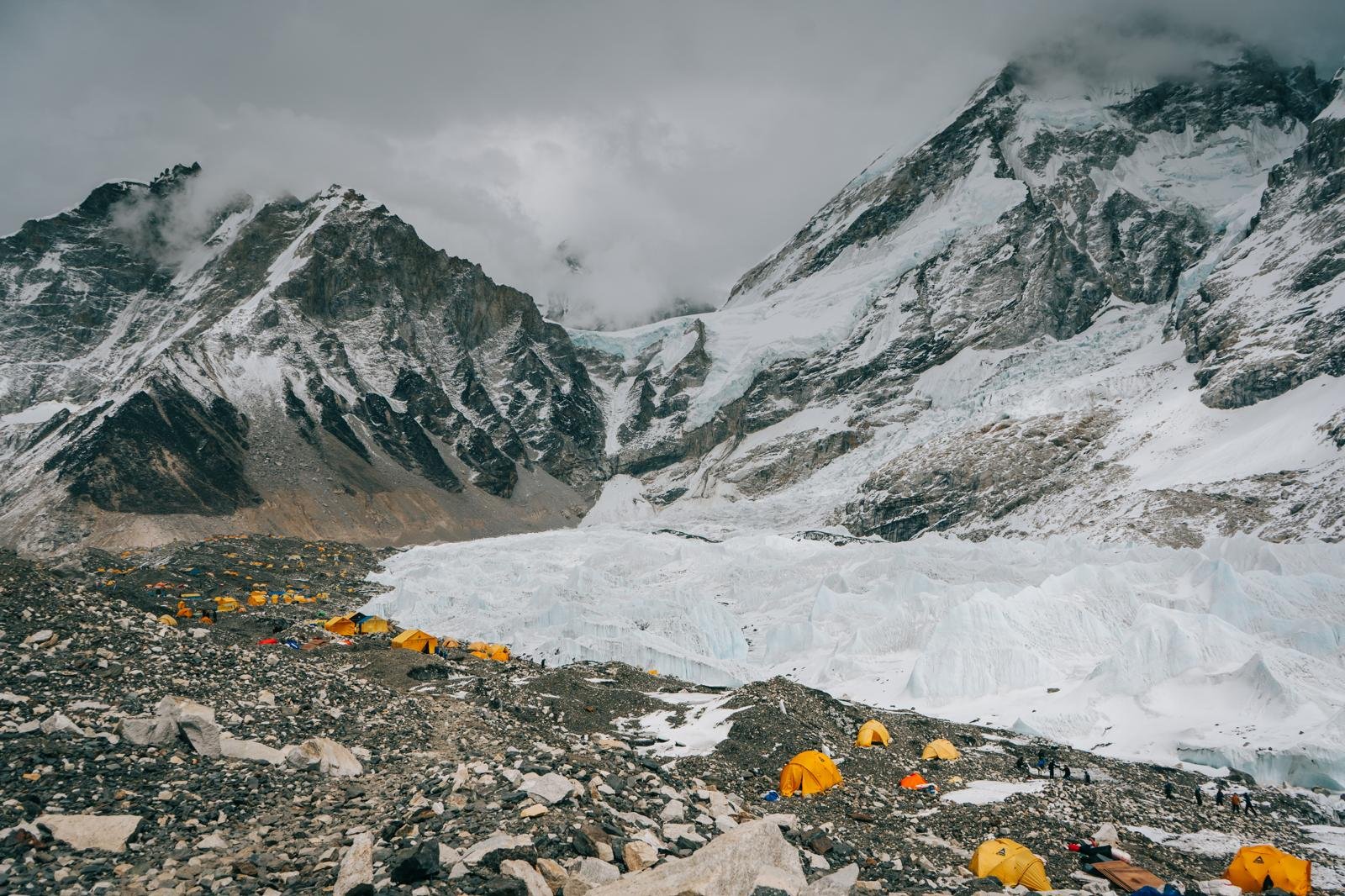
At 8,000m, the air still contains approximately 21% oxygen, but atmospheric pressure is much lower, meaning each breath provides far fewer oxygen molecules to the body. This is why supplemental oxygen can make a major difference during an 8,000m climb.
For climbers preparing for Everest or another Himalayan 8,000m expedition, understanding the oxygen system is an important part of preparation.
How Does Supplemental Oxygen Work?
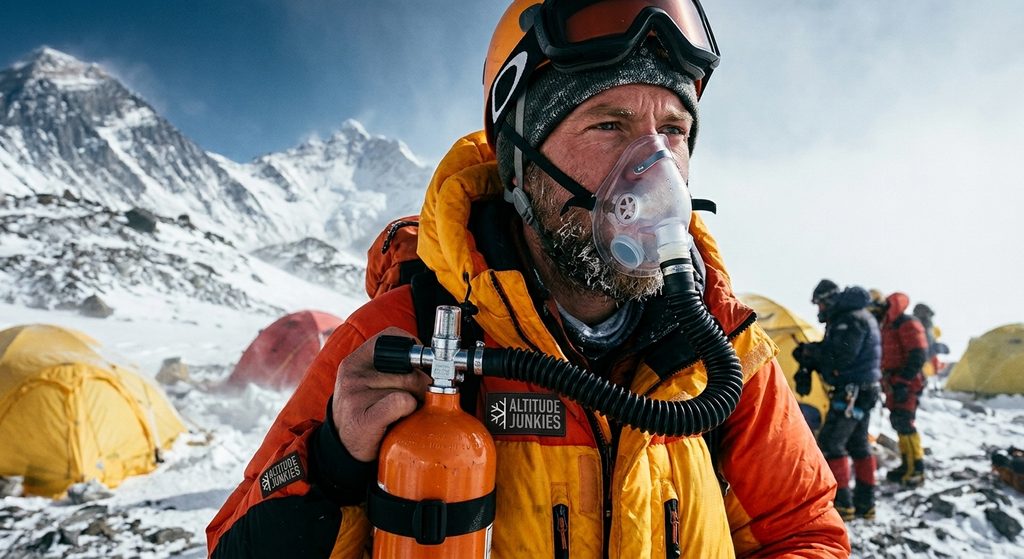
A mountaineering oxygen system has four main components:
Oxygen cylinder → regulator → hose → oxygen mask
The cylinder stores compressed oxygen. The regulator reduces the cylinder pressure and controls the flow, while the hose carries oxygen to the mask. The mask and its reservoir then deliver oxygen to the climber while minimizing wastage.
At extreme altitude, supplemental oxygen can help improve physical performance, reduce fatigue and allow climbers to function more effectively during the summit push.
When Do Climbers Use Oxygen?
There is no fixed altitude that applies to every climber. On Everest, supplemental oxygen is commonly introduced during the upper part of the expedition, often around Camp 3 or Camp 4, depending on the climber’s acclimatization and expedition strategy.
The exact plan depends on:
- Acclimatization
- Climbing speed
- Weather
- Individual condition
- Oxygen availability
- Planned summit schedule
- Emergency reserves
Oxygen Flow Rates
Regulators allow climbers to select different oxygen flow rates, normally measured in liters per minute (L/min).
Depending on the system, settings may range from approximately 0.5 L/min to 4 L/min, with some systems offering higher settings.
The basic rule is:
Higher flow = more oxygen consumed = shorter cylinder duration.
The appropriate flow should be determined with experienced expedition personnel rather than simply choosing the lowest setting to make a bottle last longer.
How Long Does an Oxygen Bottle Last?
Duration depends on cylinder capacity and flow rate.
For example, a 4-liter cylinder filled to 300 bar contains approximately 1,200 liters of oxygen.
The theoretical duration would be:
- 1 L/min: about 20 hours
- 2 L/min: about 10 hours
- 3 L/min: about 6 hours 40 minutes
- 4 L/min: about 5 hours
Actual duration can be shorter because of temperature, mask leakage, breathing rate, regulator performance and other factors.
Why Is the Oxygen Mask Special?
An Everest oxygen mask is designed specifically for extreme cold and altitude.
The mask normally includes a reservoir and valves that help deliver oxygen efficiently and separate exhaled air from the oxygen supply.
One of the biggest problems is freezing. A climber’s breath contains moisture, which can freeze around the mask, valves and regulator in extreme temperatures. Modern mask designs therefore focus heavily on valve protection and reducing freezing problems.
The History of Oxygen on Everest
Supplemental oxygen was first used on Everest during the 1922 British expedition. Early equipment was extremely heavy, with the complete system weighing around 15kg.
In 1953, Hillary and Tenzing used a significantly improved system during the first successful ascent of Everest.
In 1963, improvements such as the Maytag/Hornbein mask further developed high-altitude oxygen equipment.
In 1978, Reinhold Messner and Peter Habeler climbed Everest without supplemental oxygen, proving that an ascent without bottled oxygen was possible.
Since then, oxygen equipment has continued to become lighter, more efficient and more reliable.
What Has Changed in Modern Oxygen Systems?
Modern systems focus on:
- Higher-pressure cylinders
- Lower weight
- More efficient masks
- Better regulators
- Improved valve protection
- Better resistance to freezing
- More accurate flow control
The overall goal is simple:
Deliver more usable oxygen while carrying less weight.
Final Thoughts
From the heavy oxygen systems of the 1920s to today’s lightweight, high-pressure cylinders and specialized masks, oxygen technology has changed dramatically.
But the basic principle remains the same:
Cylinder → regulator → hose → mask → climber.
For an Everest expedition, oxygen is not simply another piece of equipment. It is an important part of the overall expedition logistics and summit strategy, requiring careful planning of flow rates, equipment, and oxygen supply.
Altitude Junkies recommends that climbers use supplemental oxygen systems only with proper training, equipment familiarization and experienced expedition support.
 using WordPress and
Comments are closed