
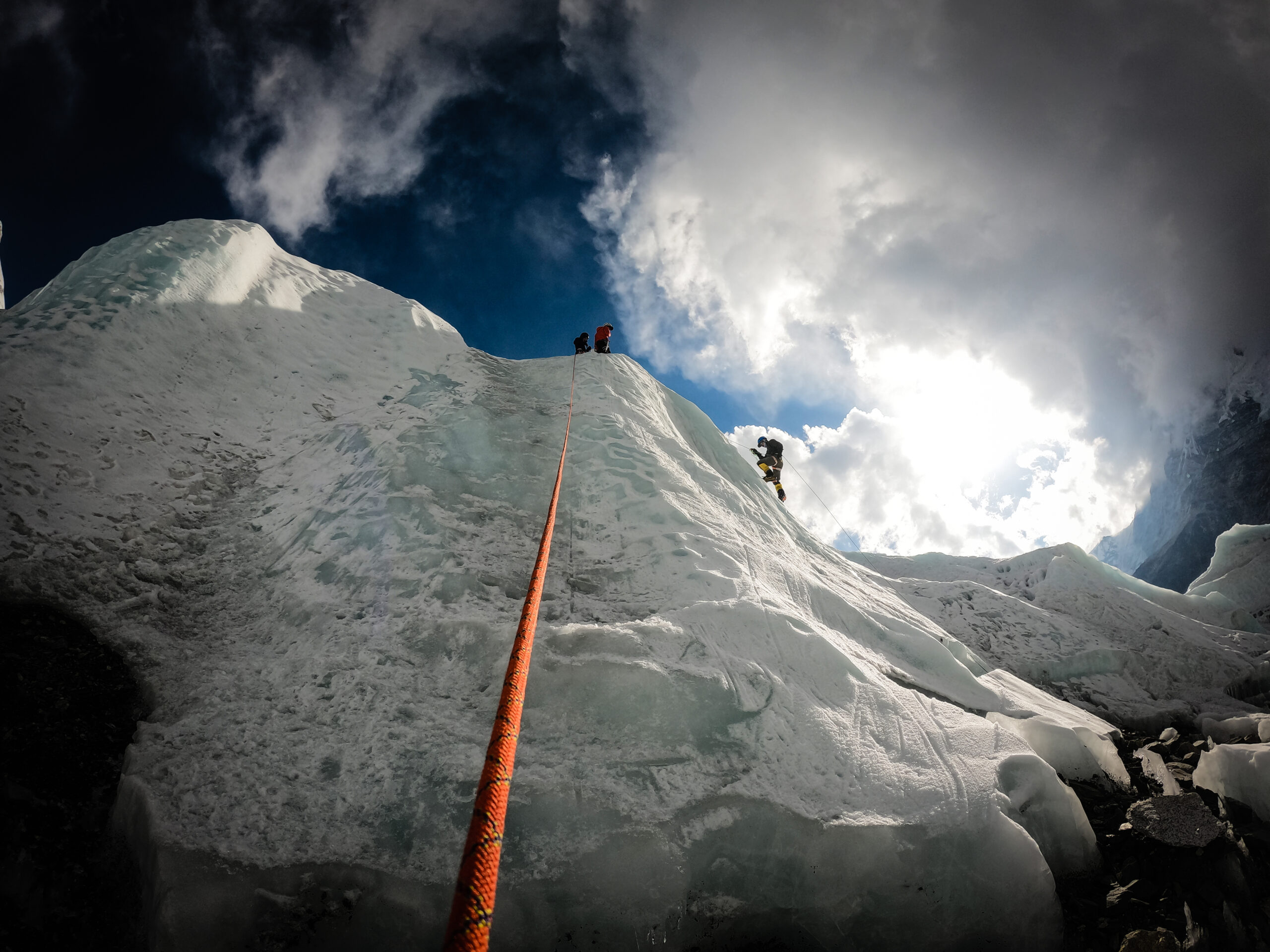
When climbers look at an Everest expedition, one of the most visible pieces of climbing infrastructure is the fixed rope. But fixed ropes are not installed in exactly the same way on every 8,000m mountain.
The route on Everest is very different from the route on Manaslu, Dhaulagiri, Annapurna, Makalu or Lhotse. Some mountains have long, steep fixed-rope sections used by hundreds of climbers, while others require a much smaller and more specialized rope-fixing operation.
The rope-fixing process depends on the terrain, route, glacier conditions, technical difficulty, number of climbers, and expedition strategy.
Who Fixes the Ropes?
On Nepal’s major 8,000m peaks, fixed ropes are generally established by experienced Sherpa and high-altitude climbing teams.
The organization varies by mountain and season.
On heavily commercialized mountains such as Everest and Manaslu, rope fixing is normally coordinated before the main summit period so that multiple expedition teams can use the established route.
On less commercial mountains, rope fixing may be handled by a smaller team working specifically for the expedition groups attempting the mountain.
The rope-fixing team usually reaches the difficult sections ahead of the main climbing teams.
Everest: The Most Developed Fixed-Rope System
Everest has one of the most extensive fixed-rope systems in Himalayan mountaineering.
The route contains several very different environments, from the constantly moving Khumbu Ice-fall to steep snow and mixed terrain above the Western Cwm.
Khumbu Ice-fall
The lower section is managed differently from the upper mountain because the glacier is constantly moving.
The Ice-fall Doctors establish and maintain the route, including fixed ropes and ladders, and regularly adjust the route as crevasses and seracs change.
This is not a one-time installation.
The route can change during the climbing season.
Western Cwm and Lhotse Face
Above the Ice-fall, fixed ropes are used on selected steep sections.
The Lhotse Face is one of the most recognizable fixed-rope sections on Everest. Climbers generally ascend the steep blue ice using ascenders attached to the fixed line.
South Col to the Summit
Higher on the mountain, fixed ropes continue through technically exposed sections toward the summit.
At this altitude, the challenge is not simply climbing the rope. Climbers are moving slowly, wearing thick gloves, carrying oxygen systems and operating in extremely cold conditions.
Everest therefore requires a large-scale rope-fixing operation involving route preparation, installation and repeated maintenance.
Lhotse: Steep Ice and a Shared Lower Route
Lhotse shares much of the lower climbing route with Everest before separating toward the Lhotse Face and summit.
The most important fixed-rope section is the Lhotse Face, where climbers ascend steep, hard ice.
Here, the quality and placement of anchors are particularly important because:
- The slope is steep
- Many climbers use the same line
- Climbers are exposed to long falls
- Ice conditions can change
- Heavy traffic puts significant demand on the system
The rope-fixing team must create a continuous line that allows climbers to ascend efficiently using ascenders and descend safely.
Manaslu: Large-Scale Commercial Rope Fixing
Manaslu has become one of Nepal’s busiest 8,000m mountains, particularly during the autumn season.
Because many commercial teams attempt a Manaslu expedition at approximately the same time, fixed ropes play a major role in the climbing strategy.
Ropes are commonly established through the higher camps and technical sections before the main summit push.
The exact route can change according to snow and mountain conditions.
One important characteristic of Manaslu is the amount of snow and avalanche-related terrain. The rope-fixing team therefore has to consider not only steepness but also snow stability and changing route conditions.
For commercial climbers, the fixed rope provides a defined route through sections that might otherwise require independent protection.
Dhaulagiri: A More Serious Rope-Fixing Environment
Dhaulagiri is considerably less commercialized than Everest or Manaslu.
The mountain’s terrain can involve:
- Large glaciers
- Steep snow slopes
- Ice
- Avalanche-prone terrain
- Exposed ridges
- Changing route conditions
Because there are fewer climbers, the fixed-rope infrastructure may be more limited than on Everest.
This makes the rope-fixing team particularly important.
Instead of simply installing a long continuous line for large numbers of commercial climbers, the team has to determine where fixed protection is actually required and how the route can safely be established for the expedition.
Annapurna I: Route Conditions Can Dictate the Rope System
Annapurna I is known for complex and serious high-altitude terrain.
The fixed-rope system can include steep snow and ice sections, but the exact configuration depends heavily on the route and conditions during a particular season.
The major concern is not simply technical climbing.
Avalanche exposure and route stability are major considerations.
A fixed rope does not make an avalanche-prone slope safe.
The rope-fixing team therefore has to make decisions based on current mountain conditions rather than simply following a permanent route.
This is an important distinction for climbers who assume that a fixed rope means the route is automatically safe.
Makalu: Technical Climbing Requires More Than Fixed Rope
Makalu is one of Nepal’s most technical 8,000m peaks.
The route involves steep snow, ice, mixed climbing and exposed terrain, particularly on the upper mountain.
While fixed ropes are used where appropriate on a Makalu expedition, climbers should not think of it as simply an ascender-on-a-rope mountain.
The technical nature of the route means climbers may still need to:
- Climb independently
- Manage technical climbing equipment
- Cross mixed terrain
- Negotiate exposed ridges
- Make technical transitions
The fixed rope provides protection and efficiency where established, but the climber still needs strong technical mountaineering skills.
What Determines Where a Rope Is Fixed?
The rope-fixing team normally considers several factors before deciding where to establish fixed lines.
1. Steepness
Steeper terrain generally requires more protection.
2. Exposure
A relatively easy slope can still require a fixed rope if a fall has serious consequences.
3. Surface
Snow, ice, and rock require different anchoring approaches.
4. Route Conditions
A route may move because of glacier movement, snowfall or changing ice conditions.
5. Traffic
A section used by hundreds of climbers requires a different approach from a route used by a small expedition.
6. Technical Difficulty
More technical sections may require fixed ropes, intermediate anchors or other protection.
How Are the Anchors Installed?
The anchor system depends on the terrain.
On snow, suitable snow anchors may be used.
On ice, the team may use ice-specific protection.
On rock, appropriate rock protection or natural features may be used.
The important point is that there is no single anchor system for every 8,000m mountain.
The rope-fixing team chooses the appropriate system according to the actual terrain and conditions.
How Does Rope Fixing Work at 8,000m?
Rope fixing is usually done progressively.
A simplified sequence looks like this:
Base Camp → establish route → fix lower technical sections → move higher → establish additional anchors → connect rope sections → inspect → maintain
The team may work ahead of the main expedition groups.
Once the route is established, climbers follow the fixed line using appropriate climbing equipment.
The rope-fixing team may then return to inspect or repair sections before the summit period.
Why Fixed Ropes Need Maintenance
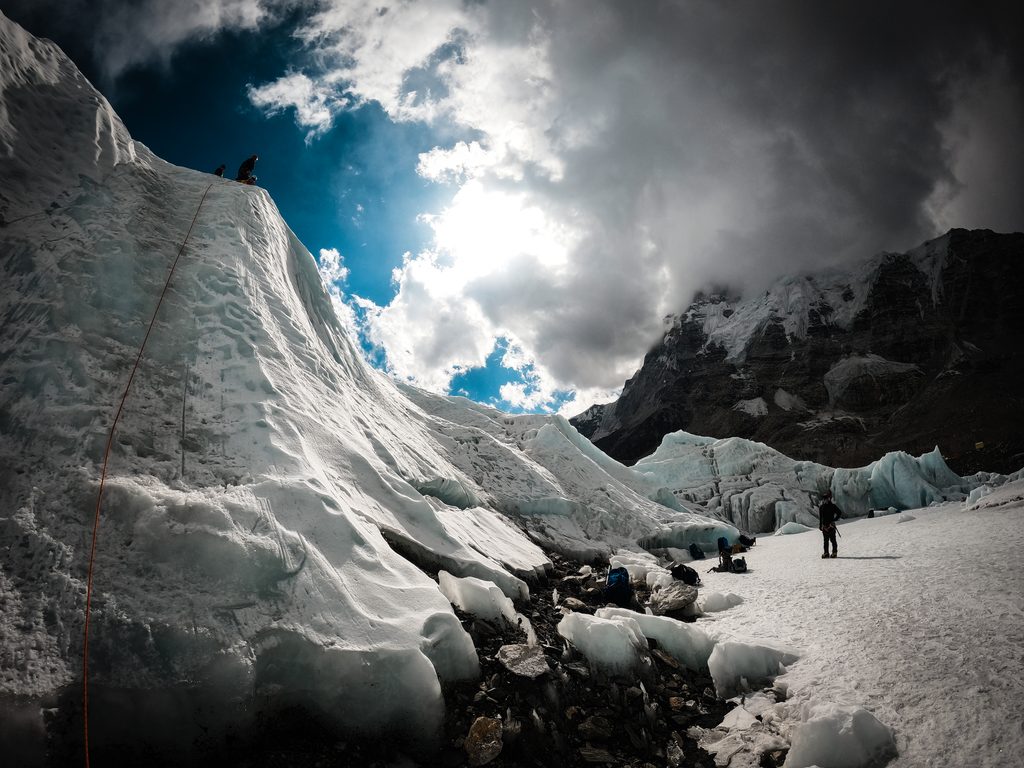
A fixed rope on an 8,000m mountain is exposed to extreme conditions.
It can be affected by:
- Rock abrasion
- Sharp ice
- Snow loading
- Wind
- UV exposure
- Repeated climber traffic
- Anchor movement
- Glacier movement
On Everest’s Khumbu Ice-fall, the situation is even more dynamic because the glacier itself is moving.
This means a rope system can require continuous inspection and adjustment throughout the season.
Fixed Rope Does Not Mean a Risk-Free Route
This is one of the most important points for anyone planning an 8,000m expedition.
A fixed rope provides protection, but it does not remove the mountain’s objective hazards.
A climber can still face:
- Avalanche
- Serac collapse
- Rockfall
- Crevasses
- Extreme weather
- Altitude sickness
- Equipment failure
- Falling climbers
- Exhaustion
A fixed rope should therefore be viewed as one component of the overall climbing system, not a guarantee of safety.
Everest vs Other 8,000m Mountains
The difference becomes clearer when comparing the major peaks.
Everest: Extensive fixed-rope infrastructure, large climbing teams and continuous route maintenance.
Lhotse: Long steep ice sections, particularly on the Lhotse Face, with significant dependence on fixed lines.
Manaslu: Highly used commercial route with substantial fixed-rope infrastructure during the main season.
Dhaulagiri: Smaller expedition environment with more variable route conditions and less extensive infrastructure.
Annapurna I: Fixed ropes are important, but avalanche exposure and route conditions are major factors.
Makalu: Fixed ropes are used on appropriate sections, but the mountain still demands strong technical mountaineering skills.
Explore our full lineup of 8,000m peak operations on our climbing blog to compare route conditions and logistics across different Himalayan peaks.
Why Sherpa Rope-Fixing Teams Are So Important
Much of the work involved in preparing an 8,000m mountain happens before the majority of climbers reach the summit route.
Rope-fixing teams:
- Assess the route
- Establish anchors
- Fix ropes
- Maintain technical sections
- Adapt to changing conditions
- Prepare the route for other climbers
Their work is physically demanding and often carried out at extreme altitude.
For commercial expeditions, the fixed rope system is therefore not simply climbing equipment—it is an important part of the mountain’s climbing infrastructure.
Final Thoughts
There is no universal method for fixing ropes on Nepal’s 8,000m mountains.
Everest is not Manaslu. Manaslu is not Makalu. Makalu is not Annapurna.
Each mountain requires a different approach based on its terrain, route, altitude, technical difficulty, weather and level of climbing activity.
On Everest, the fixed-rope system can involve large teams, extensive infrastructure and continuous maintenance. On a mountain such as Makalu or Dhaulagiri, the rope-fixing operation can be more specialized and closely connected to the specific conditions of the route.
For climbers, understanding this difference is important. When you clip into a fixed rope high on an 8,000m mountain, you are using the result of considerable route preparation, technical knowledge, Sherpa expertise and expedition logistics.
At Altitude Junkies, we believe that understanding what happens behind the scenes is an important part of understanding how a Himalayan expedition actually works. Read more expedition insights and preparation guides on the Altitude Junkies Himalayan blog.
 using WordPress and
Comments are closed